

Ace Saq Ap World History
Overview of the Brusque-Answer Question (SAQ)
The AP Exam includes 3 required brusk-answer questions (SAQ).
SAQs 1 and 2 are required and both include a text or visual stimulus. The stimulus for
SAQ 1volition be from a
secondary source, and the stimulus for
SAQ 2will be from a
primary source. The stimulus will not give away the answers, but will relate to the topics or content of at least one part of the SAQ. The topics of these questions will relate to content betwixt:
-
1200-2001 in AP World History
-
1754-1980 in AP US History
-
1600-2001 in AP European History
For SAQs 3 or 4, y'all will choose One of these questions to answer. Neither of these questions volition include a stimulus, so you will have to rely on your noesis of history entirely to respond these questions.
For SAQ 3, the topic will relate to content between:
-
1200-1750 in AP World History
-
1491-1877 in AP US History
-
1450-1815 in AP European History
For SAQ four, the topic will relate to content between:
-
1750-2001 in AP World History
-
1865-2001 in AP Us History
-
1815-2001 in AP European History
Each SAQ is made up of iii parts: A, B, and C. These parts typically progress from simple/straightforward to complex/abstruse as you movement through them.
You will have 40 minutes on the exam to answer all 3 SAQs, and yous are responsible for managing your fourth dimension as you write.
Some recommended timings:
-
For a stimulus-based question, you should programme to spend 12-fifteen minutes writing all three parts.
-
For a non-stimulus-based question, you should plan to spend 10-12 minutes writing all 3 parts.
xv min. (SAQ 1) + xv min. (SAQ 2) + 10 min. (SAQ 3 OR four) = twoscore minutes
The SAQ section is worth xx% of the exam, and information technology tests both your knowledge of history and your skill in answering questions clearly and concisely. It is worth your time to practice and develop this skill because you can get a lot of mileage out of a few simple sentences.
Answer the question, using a slice of evidence. Be brief. Explain equally needed. Respond the question and motion on to the next task.
Job Verbs
Different chore verbs tin clue you into how much detail or caption is needed for a detail part of an SAQ. A simpler task tin can utilise a shorter respond, saving y'all fourth dimension and free energy for the more complex questions.
Some of the terms typically used on AP-style questions include:
-
Place: provide information near a topic, without elaboration or caption - typically this means you just demand to give a basic answer with a specific example. You lot may be able to answer this question in simply ane sentence.
-
Depict: provide relevant characteristics well-nigh a topic - typically this means you but demand to give a basic answer with the specific item or examples needed. This respond may be slightly longer than an "identify" prompt only however doesn't require every bit much explanation.
-
Explain: explain comes in 2 flavors, "why" and "how." Explain "how" means to analyze the historical development itself, using specific historical show. Explain "why" means to analyze the motivations or reasons for the historical development, using specific historical prove.
In both cases, "explicate" questions crave the most writing. Y'all volition not merely demand an answer and an case, simply you may demand to develop the initial claim of your answer somewhat to fully accost the question.
️Writing an SAQ Response
TL;DR - Reply the prompt, include your best piece of evidence, explain yourself if needed, then motion on.
Answering an SAQ prompt is a balancing deed: y'all accept to give enough item and caption to create a complete response, but it isn't supposed to be an essay, and then you lot too have to go along things cursory. Straightforward and to-the-point answers are preferred over flowery linguistic communication.
For an "identify" or "depict" prompt, you should simply answer the question and include a piece of testify to support your respond. This tin can typically be done in 1-ii sentences, depending on the prompt.
For an "explain" prompt (and there will be at least one of these in each SAQ set you write), you volition demand to write more to create a consummate response. That's where the ACE formula can actually help.
A - respond the question. In a phrase or sentence, give a articulate merits that answers the prompt.
C - cite testify. This tin can be in the same sentence as your A, just it should be a specific, authentic, historical detail, relevant to the prompt.
E - expand/explain (equally needed). Write ane-3 boosted sentences that brand the connection between your instance and your claim explicit, and/or extend your ideas to fully answer all aspects of the prompt.
A further complication: the stimulus-based prompts sometimes require y'all to make a straight reference or connexion to the stimulus in your answer. In this case, be specific, but don't quote. Paraphrase a cardinal detail or idea and move directly into your answer.
Total AP Globe History Class Review
Scout the AP Globe History 5-Hour Finale for a comprehensive final infinitesimal cram session covering the unabridged WHAP curriculum including every unit, every time period, and every type of question you will come against during the test. After watching the Finale, invite some friends to a study with me online session to discuss the main points of the units and review anything that you may b confused on. It is a great way to for everyone to feel supported while studying!

Here is a breakdown of the review schedule and timeline:
-
30 min- Overview: sorting past theme, region, and time periods
-
1 hour - 1200-1450 CE
-
ane hour - 1450-1750 CE
-
one hour - 1750-1900 CE
-
1 hr - 1900-Present
-
xxx min - Terminal thoughts: time management, strategies, and pep talk!
Resources:
Sample Questions
SAQ 1 (Secondary Source)
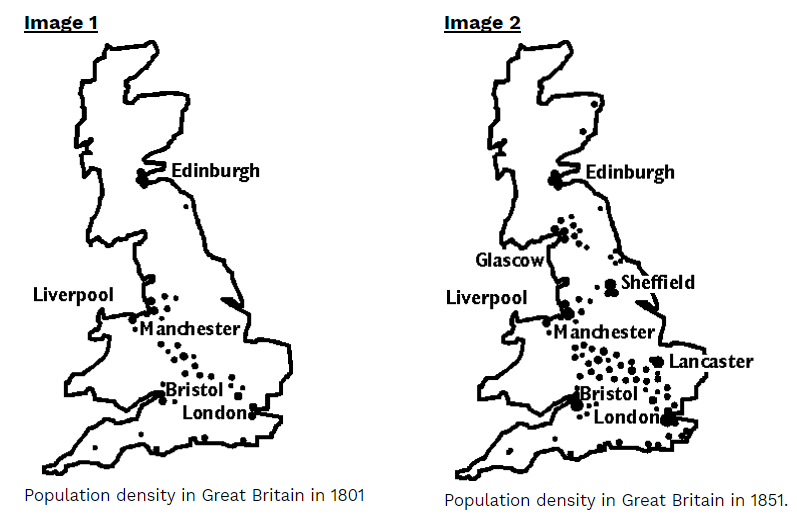
a) Describe the historical procedure represented past these two images taken together.
b) Identify ONE technological development that led to the historical procedure represented by these ii images taken together.
c) Explain ONE environmental impact of the historical process represented past these 2 images taken together.
Sample Responses
i. Every bit the Industrial Revolution spread in Cracking Britain, people increasingly moved from rural communities into cities, leading cities to increment in number and size.
-
Commentary: The thing that makes this response adequate is that it describes the underlying process behind the growth of cities in Britain. But saying that the number (or size) of cities increased would not be acceptable, because it doesn't accost the historical procedure (urbanization and the motion of people from rural communities.)
2. The development of railroads led to an increase in the size and number of cities in Britain, as appurtenances were able to exist transported to the centers of product.
-
Commentary: There are multiple correct answers for this question, and a number of technologies would be advisable to address hither. Most important is to connect the technology to its effect on the maps.
three. Every bit urbanization and population density increased in Britain, the air and h2o quality diminished. More and more than factories were built in these cities. These factories were powered by coal, which released soot and smog into the air, and they dumped industrial waste into nearby rivers and canals, which made them unsafe to beverage.
-
Commentary: An appropriate respond for this prompt should address an environmental issue such as air and/or h2o quality, illness, demographic changes, etc. An effective explanation should connect urbanization with the environmental issue and should include at least one specific case.
SAQ two (Primary Source)
Americans today, and perhaps to a greater extent than e'er before, who live inside the Castilian arrangement occupy a position in order no better than that of serfs destined for labor, or at all-time they have no more status than that of mere consumers. Even so even this status is surrounded by galling restrictions, such every bit being forbidden to grow European crops or to shop products which are imperial monopolies, or to establish factories of a type the Peninsula itself does not possess. To this add the exclusive trading privileges, even in manufactures of prime number necessity, and the barriers between American provinces, designed to prevent all exchange of merchandise, traffic, and understanding. In short, do yous wish to know what our future held? — Simply the tillage of the fields of indigo, grain, java, sugar pikestaff, cacao, and cotton; cattle raising on the broad plains; hunting wild game in the jungles; digging in the earth to mine its gold–but even these limitations could never satisfy the greed of Spain.
Simón Bolívar, "Letter from Jamaica," 1815
a) Draw economic conditions for European settlers living in Latin American colonies at the time of this letter.
b) Identify ONE historical evolution that might have contributed to Bolívar'due south decision to write this letter.
c) Explicate how Bolívar's point of view as an educated Creole might have afflicted the writing of this letter.
SAQ 3 (no stimulus)
a) Identify ONE cultural consequence of the growth of substitution networks from 1200-1450.
b) Identify ONE environmental consequence of the growth of substitution networks from 1200-1450.
c) Explain ONE mode cultural and environmental exchange intensified from 1450-1750.
SAQ 4 (no stimulus)
a) Identify one cause of global conflict in the first half of the 20th century.
b) Identify one curt-term upshot of global conflict in the outset half of the 20th century.
c) Explain one long-term effect a conflict from the early on 20th century had on relations between states in the latter part of the century.

Ace Saq Ap World History,
Source: https://library.fiveable.me/ap-world/saq/saq-overview/study-guide/QhX0r70JZkonO0StRBbt
Posted by: fergusondired1967.blogspot.com
0 Response to "Ace Saq Ap World History"
Post a Comment