

The Beginning Of The Maasai
The Maasai People of Africa, a story
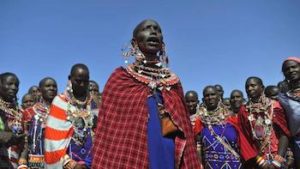
*The Maasai people are historic on this engagement in 1400. They are a Black African Nilotic ethnic grouping inhabiting northern, central, and southern Kenya and northern Tanzania. They are among the best-known local populations internationally due to their residence virtually the many game parks of the African Keen Lakes, and their distinctive customs and dress.
The Maasai speak the Maa language a fellow member of the Nilotic language family unit that is related to the Dinka, Kalenjin, and Nuer languages. Except for some elders living in rural areas, most Maasai people speak the official languages of Kenya and Tanzania, Swahili and English. The Maasai population has been reported as numbering ane,189,522 in Kenya in the 2019 demography, compared to 377,089 in the 1989 census. Culturally, jumping is the essence of the signature Maasai Adamu or jumping dance. A ascension beat, sweeping emotion into its path. A universal rhythm. ... For the Maasai, theirs is a celebration to marker the rite of passage, to welcome young men to the next stage of their lives. In the 21st century, the Tanzanian and Kenyan governments accept instituted programs to encourage the Maasai to abandon their traditional semi-nomadic lifestyle, just the people have continued their age-former customs. Many Maasai tribes throughout Tanzania and Kenya welcome visits to their villages to experience their civilization, traditions, and lifestyle, in render for a fee.
The Maasai arrived in the 15th century via Due south Sudan. Most Nilotic speakers in the area, including the Maasai, the Turkana, and the Kalenjin, are pastoralists and are famous for their fearsome reputations as warriors and cattle-rustlers. The Maasai and other groups in Eastward Africa accept adopted community and practices from neighboring Cushitic-speaking groups, including the age ready system of social organization, circumcision, and vocabulary terms. Maasai society is strongly patriarchal in nature, with elderberry men, sometimes joined past retired elders, deciding nigh major matters for each Maasai group. A full torso of oral police covers many aspects of behavior. Formal capital punishment is unknown, and normally payment in cattle volition settle matters. An out-of-court process is besides practiced calledamitu, 'to make peace, orarop, which involves a substantial apology.
The monotheistic Maasai worship a unmarried deity calledEnkai orEngai. Engai has a dual nature: Engai Narok (Black God) is benevolent, and Engai Na-nyokie (Red God) is vengeful. At that place are also two pillars or totems of Maasai gild: Oodo Mongi, the Scarlet Cow, and Orok Kiteng, the Blackness Cow with a subdivision of five clans or family copse. The Maasai also have a totemic animal, which is the lion; withal, the beast can exist killed. The way the Maasai kill the lion differs from trophy hunting as information technology is used in the rite of passage anniversary. The "Mountain of God", Ol Doinyo Lengai, is located in northernmost Tanzania and can exist seen from Lake Natron in southernmost Republic of kenya.
Maasai habiliment the color red because it symbolizes their culture and they believe it scares abroad lions. Also, most of the men wear a Shuka, which is a cherry-red robe. The women wear clothes that are colorful and decorated with beads. ... Warriors wear their hair in braids that are dyed ruby. The key homo figure in the Maasai religious organization is the laibon whose roles include shamanistic healing, divination and prophecy, and ensuring success in war or acceptable rainfall. Today, they have a political role as well due to the height of leaders. Whatsoever ability an individual laibon had was a function of personality rather than position. Many Maasai have too adopted Christianity and Islam.
The Maasai are known for their intricate jewelry and for decades, have sold these items to tourists equally a business organization. A one time high infant mortality charge per unit among the Maasai has led to babies not truly beingness recognized until they reach an age of 3 monthsilapaitin. Educating Maasai women to use clinics and hospitals during pregnancy has enabled more infants to survive. The exception is plant in extremely remote areas. For Maasai living a traditional life, the end of life is virtual without anniversary, and the dead are left out for scavengers. A corpse rejected past scavengers is seen as having something wrong with information technology, and liable to crusade social disgrace; therefore, it is non uncommon for bodies to be covered in fat and claret from a slaughtered ox. Burying has in the past been reserved for nifty chiefs since it is believed to be harmful to the soil.
Traditional Maasai lifestyle centers around their cattle which establish their master source of food. The measure of a human's wealth is in terms of cattle and children. A herd of 50 cattle is respectable, and the more children the better. A man who has enough of one just not the other is considered to be poor. A Maasai religious conventionalities relates that God gave them all the cattle on earth, leading to the belief that rustling cattle from other tribes is a matter of taking back what is rightfully theirs, a practice that has become much less common. All of the Maasai's needs for food are met by their cattle. They eat the meat, drink the milk daily, and drinkable the claret on occasion. Bulls, goats, and lambs are slaughtered for meat on special occasions and for ceremonies. Though the Maasai'southward entire way of life has historically depended on their cattle, more than recently with their cattle dwindling, the Maasai take grown dependent on food such as sorghum, rice, potatoes, and cabbage (known to the Maasai every bit goat leaves).
A traditional pastoral lifestyle has become increasingly difficult due to outside influences of the modern world. Garrett Hardin's article, outlining the "tragedy of the commons", as well every bit Melville Herskovits' "cattle complex" helped to influence ecologists and policymakers almost the harm Maasai pastoralists were causing to savannah rangelands. This concept was afterward proven false by anthropologists but is still deeply ingrained in the minds of ecologists and Tanzanian officials. This influenced British colonial policymakers in 1951 to remove all Maasai from the Serengeti National Park and relegate them to areas in and around the Ngorongoro Conservation Expanse (NCA). The plan for the NCA was to put Maasai interests above all else, but this promise was never met. The spread of HIV was rampant.
Due to an increment in Maasai population, loss of cattle populations to disease, and lack of available rangelands the Maasai were forced to develop new ways of sustaining themselves. Also, new park boundaries, the incursion of settlements and farms by other tribes affected sustenance. This is also the chief reason for the pass up in wild animals-habitat loss, with the second being poaching. Many Maasai now cultivate maize and other crops to get past, a practice that was culturally viewed negatively. Tillage was first introduced to the Maasai by displaced WaArusha and WaMeru women who married Maasai men; subsequent generations practiced a mixed livelihood.
To further complicate their situation, in 1975 the Ngorongoro Conservation Surface area banned cultivation practices. In club to survive, they are forced to participate in Tanzania's monetary economy. They take to sell their animals and traditional medicines in society to buy food. The ban on tillage was lifted in 1992 and cultivation has again become an of import role of Maasai livelihood. Park boundaries and state privatization has continued to limit grazing area for the Maasai and have forced them to change considerably. Over the years, many projects accept begun to help Maasai tribal leaders find ways to preserve their traditions while also balancing the education needs of their children for the modern globe. The emerging forms of employment amongst the Maasai people include farming, business (selling of traditional medicine, running of restaurants/shops, buying and selling of minerals, selling milk and milk products by women, embroideries), and wage employment (as security guards/ watchmen, waiters, tourist guides), and others who are engaged in the public and individual sectors.
Many Maasai have moved away from the nomadic life to positions in commerce and government. Yet despite the sophisticated urban lifestyle they may lead, many will happily head homewards dressed in designer apparel, merely to emerge from the traditional family unit homestead wearing a Shuka (a colorful piece of cloth), cowhide sandals, and carrying a wooden club (o-rinka) - at ease with themselves.

The Beginning Of The Maasai,
Source: https://aaregistry.org/story/the-maasai-people-a-brief-story/
Posted by: fergusondired1967.blogspot.com
0 Response to "The Beginning Of The Maasai"
Post a Comment